The topic for today was inverse functions.
The inverse of a given function, f(x), is derived by taking the order pairs that make up f(x) and switching the inputs and outputs. So if (a, b) is a point on f(x), then (b, a) is a point on the inverse of f(x).
Note the inverse of a function might not be a function. No biggie.
(notes for Friday)
Showing posts with label functions. Show all posts
Showing posts with label functions. Show all posts
Monday, September 14, 2009

Thursday, September 10, 2009
Sept 10 - Function Operations (including Composition)
We had a quiz in class today. The bonus was a bit of a fiasco for my 6th period class - but I have a solution for that - I'll talk about it in class tomorrow.
Function composition is simply the operation of substituting one function into another one. If we have two functions f(x) and g(x), I can write f(g(x)) ("f of g of x") or g(f(x)) ("g of f of x"). Generally speaking, they will not be the same (function composition is not commutative). A couple of the problems may be tricky because you have to determine the output of the function from a graph, not a formula.
My notes for today are brief.

Wednesday, September 2, 2009
September 2 - Piecewise, Increasing/Decreasing
Two different topics today.
First, I reviewed piecewise functions, specifically how they are graphed. For now we will use the calculator to graph functions. Eventually, we will be able to work with piecewise functions without relying on the calculator.
The other idea was describing when a function is increasing, decreasing or constant. Remember, that when you determine the interval on which a function is increasing, you are describing x values. Also, the convention is always to use open intervals to describe increasing or decreasing behavior.

Tuesday, September 1, 2009
September 1 - Domain and Range
Determining the domain of a function is fairly straightforward. There are a couple things to consider - division by zero and the presence of negative numbers in an even root.
Determining the range of a function is a little more involved. For me, range is a visual thing and so I encourage you to graph functions. As we go on this semester, there will be more functions you can graph on your own and fewer functions for which a calculator will be necessary. For now (and for the quiz on Thursday), the expectation will be if I ask you for range, you will either graph the function on your calculator or I will give you the graph.

Determining the range of a function is a little more involved. For me, range is a visual thing and so I encourage you to graph functions. As we go on this semester, there will be more functions you can graph on your own and fewer functions for which a calculator will be necessary. For now (and for the quiz on Thursday), the expectation will be if I ask you for range, you will either graph the function on your calculator or I will give you the graph.

Monday, August 31, 2009
August 31 - Functions
We spent most of today going over the homework from Thursday night - drawing graphs to represent different real world functions.
I mentioned to my sixth period class something that I should have told my 1st and 3rd period classes - while you were presented a lot of information in class today, I'm not going to hold you fully responsible for it. If you forget for now that I can model how a rumor spreads with a "logistics model," that's fine. My main goal for today was to impress upon you the variety of functions that are necessary to model real world behavior.
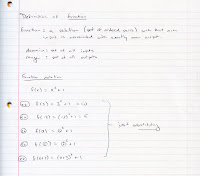
The main concepts for today were the definition of a function and how function notation works.
I mentioned to my sixth period class something that I should have told my 1st and 3rd period classes - while you were presented a lot of information in class today, I'm not going to hold you fully responsible for it. If you forget for now that I can model how a rumor spreads with a "logistics model," that's fine. My main goal for today was to impress upon you the variety of functions that are necessary to model real world behavior.
The main concepts for today were the definition of a function and how function notation works.

Subscribe to:
Posts (Atom)